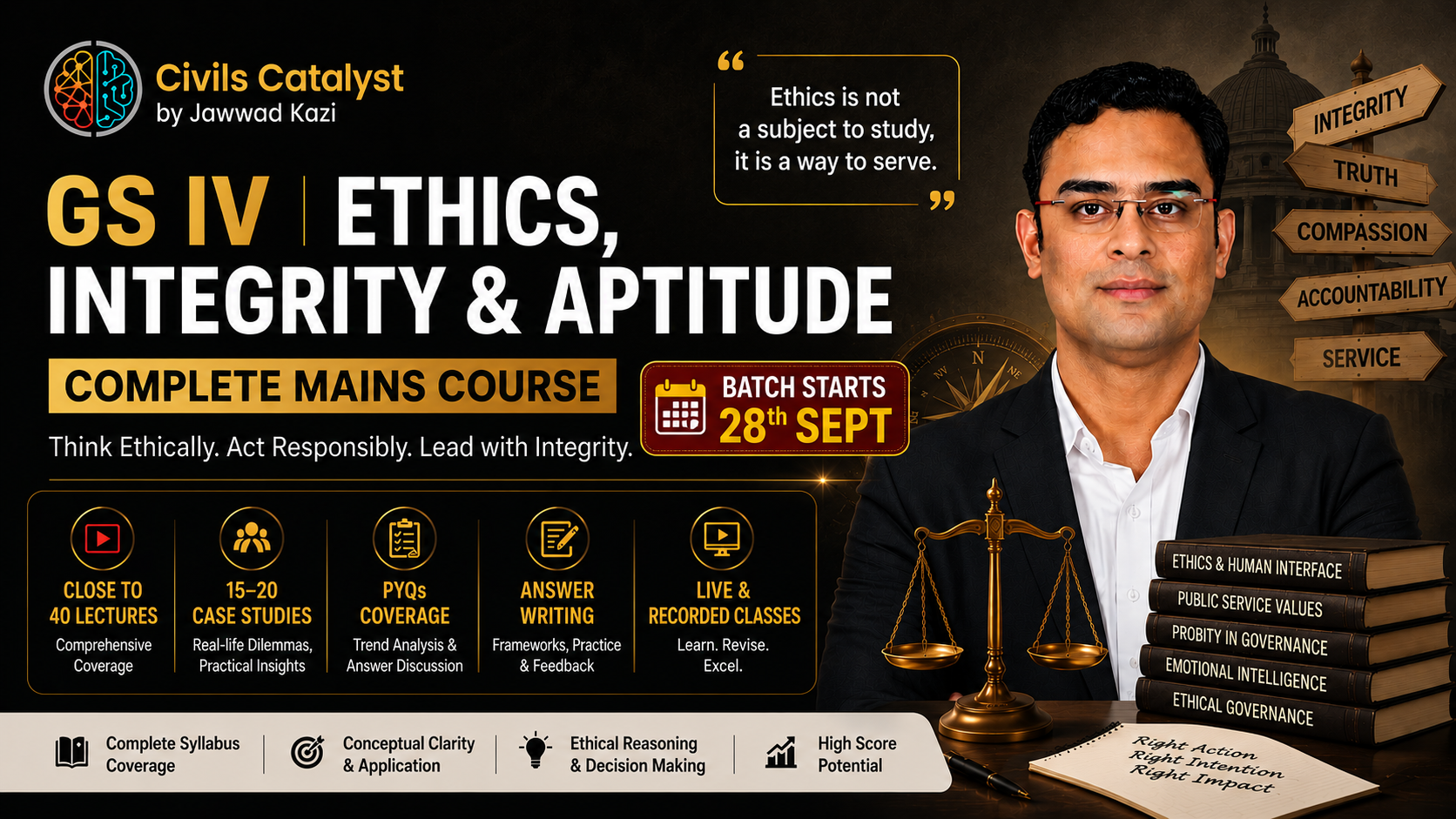
GS IV: Ethics, Integrity and Aptitude
₹8,999
₹11,999
Choose Currency:
Description
Batch Starts: 28th September
The GS Paper IV: Ethics, Integrity & Aptitude paper is one of the most decisive papers in the UPSC Civil Services Examination. More than just a scoring opportunity, it is often the difference between an average rank and a top rank.
While marks in papers such as GS Paper I usually fluctuate within a limited range, the Ethics paper has consistently demonstrated the potential to elevate scores from an average range of 110–115 to exceptionally high scores of 135+. Its effective impact on the final merit list is therefore extremely significant.
Over the last year, students associated with the program and mentorship initiatives have shown strong performance in the examination, with 24 students from Essay programme making it to the final UPSC list. Among the notable selections are:
- Zinnia Aurora (AIR 6)
- Surabhi Yadav (AIR 14)
- Aniket Ranjan (AIR 48)
- Jayant Garg (AIR 64)
- Devansh Gupta (AIR 77)
- Deeksha Patkar (AIR 88)
along with several other successful aspirants.
Why Most Aspirants Struggle in Ethics
Despite its importance, Ethics remains one of the most misunderstood papers in the examination.
There is:
- Absence of a single structured source that holistically covers the Ethics syllabus
- Exposure to excessive yet disconnected and scattered study material
- Difficulty in understanding and applying abstract ethical concepts and terminology
- Lack of clarity about what exactly UPSC expects in Ethics answers
- Confusion regarding how to balance theory, practical administration, and ethical reasoning in answer writing
As a result, many aspirants end up spending only a few days on Ethics preparation, often limiting themselves to memorising definitions without developing the:
- Analytical depth
- Administrative perspective
- Ethical reasoning
- Answer-writing maturity
required to score well.
This course has been designed to solve that problem systematically.
About the Course
This is a comprehensive, practice-oriented Ethics program aimed at building:
- Conceptual clarity
- Administrative thinking
- Ethical reasoning
- Answer-writing excellence
The objective is to help students develop the ability to think like a future civil servant while presenting answers in a structured, mature, and scoring manner.
The course will consist of 40+ detailed lectures covering the entire Ethics syllabus in depth. Every major dimension of the paper will be explained through:
- Contemporary examples
- Governance issues
- Philosophical insights
- Real administrative situations
Extensive Case Study Training
One of the defining strengths of the course will be its strong emphasis on Case Study training.
The program will include:
- 15–20 dedicated case study discussions
- Realistic ethical dilemmas faced by civil servants
- Structured approaches to ethical decision-making
Special focus will be given to:
- Stakeholder analysis
- Conflict resolution
- Ethical frameworks
- Administrative practicality
- Balanced decision-making
What the Course Covers
The program will comprehensively address:
- Complete coverage of Ethics terms & terminologies
- Previous Year Questions (PYQs) with trend analysis
- Quote-based and philosophical questions
- Framework-based answer writing for Section A & B
- Real-life examples and administrative anecdotes
- Committee references and contemporary illustrations
- Value addition for multidimensional answers
- Structured note-making techniques for revision
- Integrated answer-writing practice throughout the course
Designed for Both Beginners & Experienced Aspirants
The course is structured in a way that:
- Beginners can gradually build strong command over the subject with clarity and confidence
- Experienced aspirants can identify gaps in their previous preparation and significantly improve answer quality
Live + Recorded Access
Classes will be conducted in:
- Live Mode
- Recorded Mode
This allows students the flexibility to:
- Revise concepts multiple times
- Learn at their own pace
- Continuously refine understanding
The teaching approach will remain:
- Interactive
- Practical
- Discussion-oriented
rather than limited to theoretical dictation.
The Core Objective
The ultimate objective of the course is simple: to transform ethics from an uncertain and intimidating paper into a predictable high-scoring advantage in the UPSC mains exam.
Loading...
₹8,999